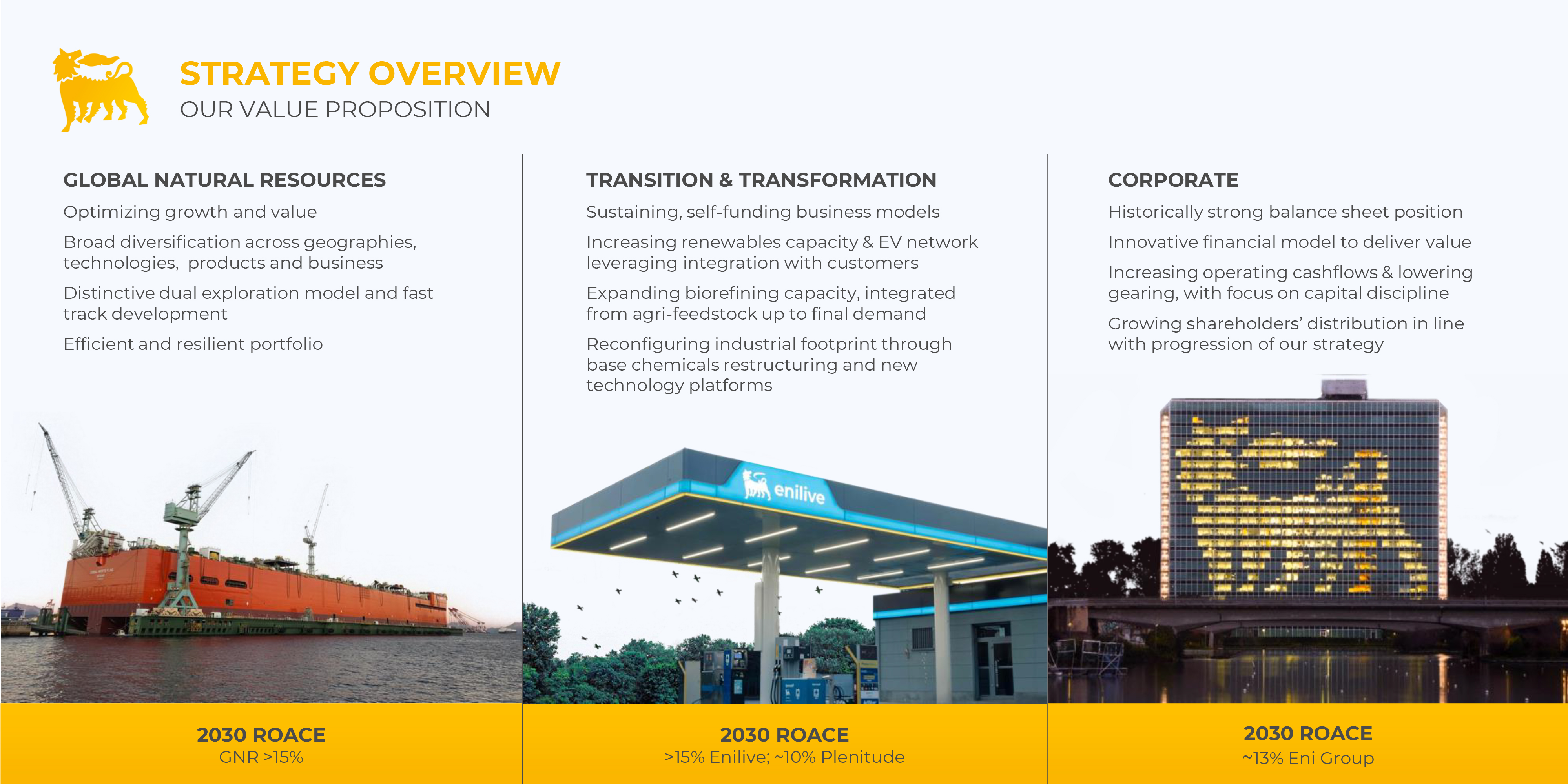
In an increasingly complex and rapidly evolving energy landscape, our strategic focus remains unchanged: to create sustainable long-term value by addressing the real needs of our customers. We bring together new and established technologies, leverage our in-house expertise and develop innovative business and financial models that enable us to capture emerging opportunities. Our ability to create value for shareholders is closely tied to our commitment to delivering energy solutions that are affordable, reliable and progressively lower in carbon.
Four connected and synergistic pillars underpin Eni’s strategy:
To deliver these objectives successfully through the cycle requires a consistency of purpose and strategy. At the same time, amid rapid change and volatility, it is also essential that we are agile and innovative – unafraid in challenging mainstream models and old conventions.
This is a full industrial strategy. We own resources, assets and projects that visibly underpin our growth objectives. We will deliver the secure, affordable and progressively lower-carbon energy our customers demand. Most importantly, we have the skills, the know-how, the technology and the people to deliver those projects.
Exploration & Production (E&P) remains the cornerstone of our strategy. We now have the strongest and most diversified portfolio of development and pre-development projects in the company's history, built largely organically and thanks to our sector leading exploration and project execution.
Exploration is a distinctive feature for our E&P, as we showed in the past in terms of high success rate, low cost-per-barrel and dual exploration valorization. Since 2014, we have discovered over 11 billion barrels of oil equivalent, approximately 900 million of which in 2025, with further promising prospects across the Plan period. These additions have come from multiple geographies and different plays. Our expectation is to average over 140% reserve replacement ratio over 2026-2030, as we sanction new projects. We also retain and use the option to go for early valorization of a portion of our discoveries, de-risking economic returns.
Our E&P business is outstanding and, integrating gas, trading and power activities, we aim to capture the maximum margin from our equity production.
Our production growth is accelerating. We will deliver a reported production CAGR of 3-4% to 2030, leaving room for continued, disciplined and value-enhancing dual exploration valorization and high-grading actions. The new barrels will be highly accretive to Free Cash Flow and we expect to see material ROACE improvement.
Thanks to the depth and breadth of our portfolio, spanning geographies and technologies, we have 850 kboed of new production at 2030 from projects under development, of which around 90% operated by Eni or one of our satellites.
A further strength of the portfolio is its significant exposure to Floating Liquefied Natural Gas (FLNG) technology, a flexible, cost-efficient solution in which Eni has established a world-leading position.
In Plenitude and Enilive, Eni has created two high growth integrated businesses supporting its customers in decarbonizing their energy use. In the past two years, Eni has attracted aligned capital from leading financial players into its two main Transition businesses supporting their growth, implying an enterprise value of over €23 billion.
Uniquely among our peers, we have built a stand-alone, sustainable business model for our Renewable activities. Plenitude integrates renewable energy generation, energy supply and advanced energy services, including e-mobility. Under the Strategic Plan, Plenitude's growth will be further accelerated. Installed renewable capacity is expected to grow from 5.8 GW in 2025 to around 15 GW by 2030, while the customer base will exceed 11 million. To support this growth in the most financially efficient manner, Eni has announced a plan to review the shareholding structure and deconsolidate Plenitude, accompanied by a non-proportional capital increase of €1.5 billion.
Enilive continues to develop its integrated model in sustainable mobility and biofuels. A notable feature of the Enilive plan is the construction of new capacity now underway. We are currently the largest developer of new capacity worldwide. The target is to reach 5 million tonnes of biofuel production capacity by 2030, with the optionality to produce over 2 million tonnes of Sustainable Aviation Fuel (SAF). Enilive retail business will continue to play a crucial role, in terms of both physical integration and cashflow.
These businesses are already generating significant value: Plenitude targets EBITDA of over €2.5 billion by 2030, while Enilive aims for around €3 billion, with returns growing strongly.
Eni’s disciplined financial model supports the execution of its strategy across the cycle enabling its application in a consistent manner, providing essential financial resilience, aligning capital with differing risk and reward profiles, tangibly demonstrating value creation, and generating returns to the Company’s shareholders.
Over the 2026–2030 period, we expect average annual investment of less than €6 billion — around €2 billion lower than the previous plan — thanks to further efficiency and focus initiatives as well as the deconsolidation of certain activities. In 2026, investment is expected to amount to approximately €7 billion, down on the previous year.
Thanks to the efficiency and effectiveness of Eni’s investment spend and the quality of its new projects portfolio, the Company is expected to grow in a highly competitive fashion. Cash Flow From Operations (CFFO) per share will grow at a compound annual growth rate (CAGR) of 14% to 2030, driven by accretive growth in the businesses, and supported by performance improvement initiatives and efficiency measures.
In aggregate, Eni expects to generate approximately €71 billion of CFFO over the Plan period and in excess of €40 billion of Free Cash Flow. Return on Average Capital Employed (ROACE) is expected to reach approximately 13% by 2030.
These results, combined with rigorous capital discipline, will enable Eni to maintain gearing in the range of 10–15% over the entire Plan period— an historically low level for the Company.
Our distribution policy confirms the progressive growth in shareholder value as we execute our strategy. We rank distribution as a top priority in our financial framework by allocating a percentage of the operating cashflow - a transparent link to our business performance. In the context of a strong balance sheet, new satellites and de-consolidated cashflows and lower capex, Eni raised its target distribution payout to 35-45% of CFFO from 35-40% previously. Dividend is our first priority within the capital framework. We expect to grow dividend over time while also improving its quality.
Eni Chief Executive Officer