Angola
The initiative strengthens healthcare worker training and a centralised network model designed to meet neonatal and paediatric intensive care needs.

In May 2025, the Eni Foundation signed a three-year agreement with the Angolan Ministry of Health (MINSA) to support the expansion of high-quality neonatal and paediatric intensive care services across four provinces of Angola. This will be achieved through a Hub & Spoke system (a centralised network model for managing critical patients) connecting the Azancot Hospital in Luanda with the three provincial general hospitals of Huambo, Lubango (Huila Province) and Benguela.
Objectives
The overall objective is to strengthen the Azancot Hospital’s capacity to meet neonatal and paediatric intensive care needs and to establish it as the main health centre for the Luanda metropolitan area and for the country as a whole.
- Initial Phase: This capacity-building initiative aims to enhance the skills of healthcare professionals at Azancot Hospital, improving both the quality and accessibility of paediatric care services
- “Hub and Spoke” Strategic Network: This approach is essential to establish a dedicated network for managing critical patients throughout Luanda.
- The Azancot Hospital will act as the central hub, facilitating a coordinated and efficient response to critical cases coming from the surrounding regions of Benguela, Huambo and Huila, selected by MINSA
- Emergency units located in the provinces of Benguela, Huambo and Huila will serve as the spokes of the network. They will be equipped to perform initial patient assessment and stabilisation before facilitating, where necessary, the transfer of patients to the Azancot Hospital for more specialised treatment.
- Project Expansion (Phase 2): Following a comprehensive assessment, the project will extend its activities to the provincial hospitals of Benguela, Huambo and Huila. This phase will introduce a tailored training programme designed with a train-the-trainer approach, enabling local facilitators to effectively transfer knowledge and skills to the healthcare staff of these hospitals
- Specialised Support: A training initiative developed in collaboration with the Azancot Hospital will strengthen the knowledge and skills of healthcare personnel in the three provinces, particularly in the area of intensive care. Remote support will also be provided for the transport of critical patients.
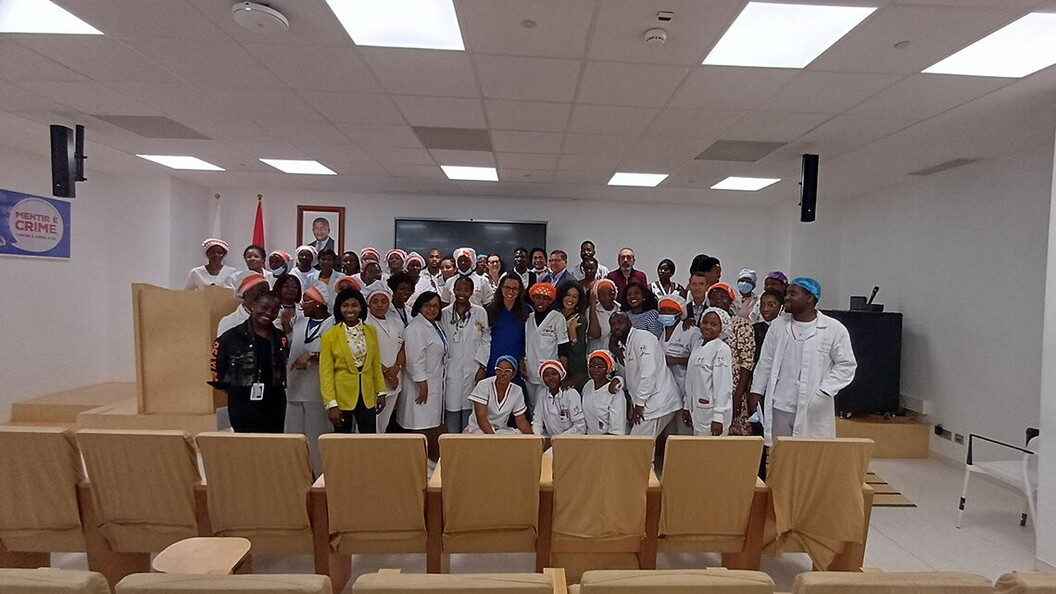
A group of people pose for a photo standing in a classroom.
First results achieved
- A total of 80 healthcare workers, including doctors and nurses, took part in classroom-based and on-the-job training sessions
- A dedicated assessment began on the structural needs of the hospital’s neonatal intensive care unit, which handles around 38,000 births per year
- The use of CPAP (Continuous Positive Airway Pressure) — a non-invasive ventilation method for newborns with critical respiratory conditions — was introduced and recommended for use in the ward. CPAP is an essential support device that avoids the need for intubation. Its application enabled the recovery of two newborns at high risk of death. After the mission, remote support to the local staff ensured a positive outcome for both infants
- A further 16 patients admitted to the ward benefited from consultations with the Gaslini team, which supported doctors and nurses daily in clinical activities.
- Sono state formate 70 persone tra medici e infermieri
- l’ospedale ha dimostrato grande soddisfazione per gli esiti positivi dell’utilizzo della CPAP. Per rispondere alle difficoltà di approvvigionamento di dispositivi in loco, è stata avviata l’adozione di sistemi artigianali per la miscelazione di ossigeno e la somministrazione di CPAP. Il personale è stato addestrato all’allestimento e il sistema si è dimostrato semplice e sostenibile.
- durante la seconda missione, la CPAP è stata impiegata in 7 pazienti con successo
- altri 18 pazienti presenti in reparto si sono avvalsi della consulenza del team Gaslini
- sono stati formati in maniera frontale 70 tra medici e infermieri del reparto di terapia intensiva su temi quali: fisiopatologia dell’insufficienza respiratoria e cura del paziente, prevenzione e controllo delle infezioni e gestione dei farmaci, e implementazione della CPAP
- è stata evidenziata la necessità di introdurre dispositivi moderni nel blocco operatorio e in sala parto ed è stata avviata la formazione del personale (coinvolgendo 10 unità) in sala di simulazione
- su invito della DG di Azancot e con il benestare della Ministra della Salute, hanno partecipato alla formazione anche 12 unità di personale dell’Ospedale Materno Infantile do Camama, il secondo ospedale Marterno Infantile di Luanda.
Duration and value of the initiative
The project has a duration of 36 months. It began in September 2025 and is supported by a total investment of €2.7 million.
Partners
Il progetto si sviluppa in partnership con il Ministero della Salute Angolano e la Gaslini Academy di Genova, che mette a disposizione un team di esperti per garantire il successo dell’iniziativa.
The project and the 2030 Agenda for Sustainable Development
Like other Eni Foundation initiatives implemented worldwide, this project aims to address the Sustainable Development Goals set by the United Nations in the 2030 Agenda. In particular: Goal 3, Good Health and Well-being (Ensure healthy lives and promote well-being for all at all ages); Goal 10, Reduced Inequalities (Reduce inequality within and among countries); Goal 17, Partnerships for the Goals (Strengthen the means of implementation and revitalise the global partnership for sustainable development).