


Page 22 - EniFor2016_Performance_eng
P. 22
20       Eni for 2016  |  Sustainability Performance


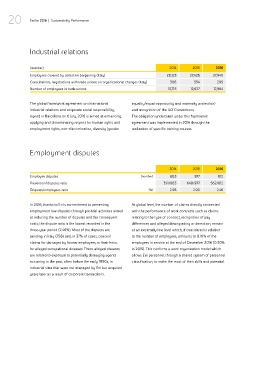
              Industrial relations


              (number)                                                      2014       2015      2016
              Employees covered by collective bargaining (Italy)           28,123    27,426     27,940
              Consultations, negotiations with trade unions on organizational changes (Italy)  308  334  295
              Number of employees in trade unions                           13,715    12,627    12,964


              The global framework agreement on international   equality/equal opportunity and maternity protection)
              industrial relations and corporate social responsibility,   and recognition of the ILO Conventions.
              signed in Barcelona on 6 July, 2016 is aimed at enhancing,   The obligation undertaken under this framework
              applying and disseminating respect for human rights and   agreement was implemented in 2016 through the
              employment rights, non-discrimination, diversity (gender   realization of specific training courses.


              Employment disputes


                                                                            2014       2015      2016
              Employee disputes                                 (number)     883       977        812
              Prevention/disputes ratio                                   391/883   648/977    562/812
              Disputes/employees ratio                             (%)      2.58       2.90      2.46


              In 2016, thanks to Eni’s commitment to preventing   At global level, the number of claims directly connected
              employment law disputes through pre-trial activities aimed   with the performance of work contracts such as claims
              at reducing the number of disputes and the consequent   relating to the type of contract, recognition of pay
              costs, the dispute ratio is the lowest recorded in the   differences and alleged downgrading or demotion, remain
              three-year period (2.46%). Most of the disputes are   at an extremely low level which, if considered in relation
              pending in Italy (758) and, in 37% of cases, concern   to the number of employees, amounts to 0.16% of the
              claims for damages by former employees, or their heirs,   employees in service at the end of December 2016 (0.30%
              for alleged occupational diseases. These alleged diseases   in 2015). This confirms a work organization model which
              are related to exposure to potentially damaging agents   allows Eni personnel, through a shared system of personnel
              occurring in the past, often before the early 1990s, in   classification, to make the most of their skills and potential.
              industrial sites that were not managed by Eni but acquired
              years later as a result of corporate transactions.

