


Page 32 - EniFor2016_Performance_eng
P. 32
30       Eni for 2016  |  Sustainability Performance


                Relations with vendors,


                customers and consumers


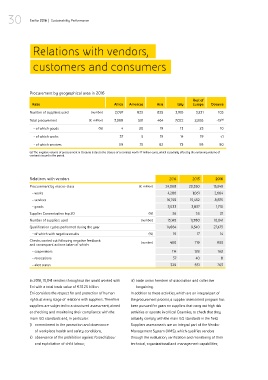
              Procurement by geographical area in 2016
                                                                                       Rest of
               Ratio                                Africa  Americas   Asia    Italy   Europe  Oceania
              Number of suppliers used   (number)   2,097     825      625     3,160    3,231     103

              Total procurement          (€ million)  3,069   501      464     7,022   2,208     -15 (a)
                - of which goods             (%)       4       20       19       13       23       10
                - of which works                      37        5       19       14       19        <1

                - of which services                   59       75       62       73       58      90
              (a) The negative volume of procurement in Oceania is due to the closure of a contract worth 47 million euros, which is partially offset by the remaining volume of
              contracts issued in the period.


              Relations with vendors                                        2014       2015      2016
              Procurement by macro-class                       (€ million)  24,068   20,350     13,249
               - works                                                     4,286       1,061    2,664
               - services                                                  16,749     15,452    8,875
               - goods                                                     3,033      3,837      1,710
              Supplier Concentration top 20                         (%)       36        35         21
              Number of suppliers used                          (number)    13,145    11,380    10,041
              Qualification cycles performed during the year               14,664     9,540     27,473
               - of which with negative results                    (%)        15         17        14
              Checks carried out following negative feedback    (number)     480        719      933
              and consequent actions taken of which:
               - suspensions                                                  114      128        162
               - revocations                                                  37        40         8
               - alert status                                                329       551        763


              In 2016, 10,041 vendors throughout the world worked with   iii) trade union freedom of association and collective
              Eni with a total trade value of €13.25 billion.   bargaining.
              Eni considers the respect for and protection of human   In addition to these activities, which are an integral part of
              rights at every stage of relations with suppliers. Therefore   the procurement process, a supplier assessment program has
              suppliers are subjected to a structured assessment, aimed   been pursued for years on suppliers that carry out high risk
              at checking and monitoring their compliance with the   activities or operate in critical Countries, to check that they
              main ILO standards and, in particular:       actually comply with the main ILO standards in the field.
              i)  commitment to the promotion and observance    Suppliers assessments are an integral part of the Vendor
                of workplace health and safety conditions,   Management System (VMS), which qualifies vendors
              ii)  observance of the prohibition against forced labour    through the evaluation, verification and monitoring of their
                and exploitation of child labour,          technical, organizational and management capabilities,

